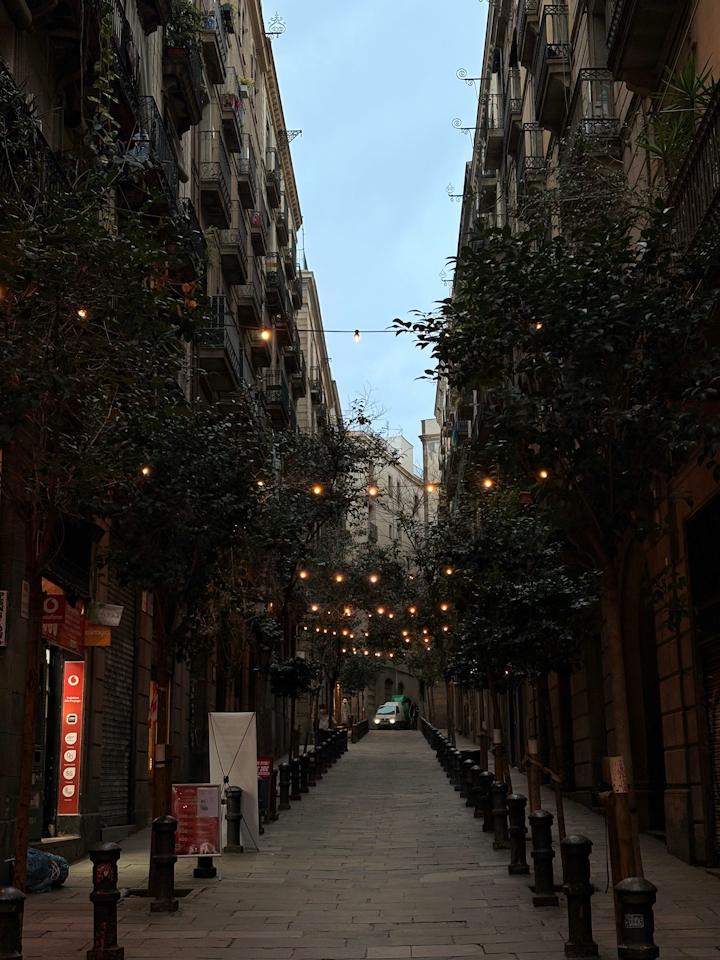
🌙 The Barrio Chino After Dark: A 3-Stop Route
The term El Barrio Chino (The Chinese Quarter) is one of the most fascinating, misunderstood, and atmospheric labels in Barcelona’s history. For decades, it was a legendary enclave of vice, cabaret, crime, and creative rebellion. Today, the area is officially known as El Raval, but the ghost of the Barrio Chino still lingers in its narrow streets, architecture, and local lore.
· Location: Carrer de Sant Pau, 65
· The Vibe: Step through the doors and you step directly into 1820. This is Barcelona’s oldest continuously running tavern, and it serves as the ultimate anchor for the old Barrio Chino identity. The ceilings are peeling, the mirrors are stained with a century of tobacco smoke, and the dusty bottles behind the counter haven't moved in decades.
· The Guide Detail: This is where Hemingway, Picasso, and Salvador Dalí would sit under the low lights, dissolving sugar cubes over forks into glasses of high-proof absinthe. It looks and feels exactly like the bohemian, chaotic haven it was a hundred years ago.
· The Story to Tell: Back in the 1920s and 30s, Marsella wasn’t just an artist's hangout; it was a sanctuary for local thieves, anarchists, and smugglers. The local police knew this, but the narrow layout of the Barrio Chino made surprise raids impossible. Instead, undercover cops would sit at the front tables.
· The Secret Detail: Regulars developed a code based on how they held their absinthe glasses. If a known police informant walked in, patrons would subtly clink their heavy glasses against the marble tables twice. The vibration traveled through the floorboards, alerting the criminals and drug dealers in the dim, windowless back room to slip out through the hidden kitchen exit before a hand could be laid on them. To this day, the back exit exists, leading into a residential stairwell.
· Location: Carrer de la Cera (Walking junction from Carrer de Sant Pau)
· The Vibe: As you leave Marsella, cut deeper into the neighborhood toward Carrer de la Cera. By night, these tightly packed apartments echo with the neighborhood’s real musical heartbeat.
· The Guide Detail: In the 1940s and 50s, the local Romani community in these exact streets fused traditional flamenco with Afro-Cuban rhythms brought in by sailors at the nearby port, inventing Rumba Catalana. Look out for the vibrant street murals and public art installations honoring musical legends like Peret, who grew up playing guitar on these street corners.
· The Story to Tell: The absolute king of this sound was a man named Peret (Pedro Pubill Calaf), who grew up right here. In the 1950s, he revolutionized guitar playing with a technique called el ventilador (the fan). He would aggressively strum the strings while simultaneously striking the wooden body of the guitar with his palm and knuckles to create a percussion beat. He was essentially a one-man drum kit and guitarist.
· The Legend: The neighborhood was so fiercely proud of Peret that when he practiced on his balcony on Carrer de la Cera, traffic would completely grind to a halt. Delivery carts, neighbors, and local characters would crowd the narrow street below, turning the alley into an impromptu street party. When the Francoist police would arrive to break up the "illegal gathering," the crowd would simply absorb the officers, hand them a glass of wine, and get them dancing along to the rhythm.
· Location: Carrer de Vila i Vilà, 99 (Just off Av. del Paral·lel)
· The Vibe: Conclude the route where the dense alleys of the Barrio Chino spill out onto the wide avenue of El Paral·lel—the historic theater district.
· The Guide Detail: Crowned by its iconic, spinning red neon windmill blades, El Molino was the undisputed capital of European avant-garde cabaret and transgressive theater. During the strict censorship of the Franco dictatorship, this venue was a masterclass in double entendres, underground expression, and raw, working-class comedy. It stands today as a beautifully restored monument to the city's rebellious nighttime history.
· The Story to Tell: The neighborhood originally named the venue El Molino Rojo (The Red Windmill), copying Paris. But Franco's regime forced them to drop the word "Rojo" because red was the color of the left-wing Republicans who lost the war.
· The Brilliant Trick: The performers at El Molino became masters of malicious compliance. The censors would sit in the front row on opening nights with notebooks, checking outfits and lyric sheets. The showgirls would wear long, modest capes that completely satisfied the dress code. However, the moment the censors looked down to write a note, the dancers would quickly flash the audience with hidden, revealing outfits beneath the capes, causing the working-class crowd to erupt in cheers. By the time the confused censor looked back up, the capes were closed, the dancers looked perfectly conservative, and the show went on. It was a nightly game of cat-and-mouse that made El Molino a symbol of freedom.
We'll build a timed route starting from your hotel, with restaurant recommendations and opening hours checked for your exact dates.
Build my itinerary →