Catalan Language: History, Dialects and Modern Use
Discover the history of the Catalan language, from its medieval origins to its modern status. Learn how Catalan differs from Spanish, where it is spoken, its main dialects and how many people use it today.
What Is the Catalan Language?
Catalan is a Romance language spoken mainly in northeastern Spain, Andorra, parts of southern France and the Italian city of Alghero in Sardinia. It is sometimes mistakenly described as a dialect of Spanish, but Catalan is a separate Romance language, descended from Latin and closely related to languages such as Occitan, French, Spanish, Portuguese and Italian.
Linguistically, Catalan occupies an interesting position between the Gallo-Romance languages of France and the Iberian Romance languages of Spain and Portugal. (Generalitat de Catalunya)
The Origins of Catalan
Catalan developed from Vulgar Latin, the form of Latin spoken by ordinary people after the Roman conquest of the Iberian Peninsula.
The language emerged gradually between approximately the 8th and 10th centuries, particularly in the counties of the Carolingian frontier known as the Marca Hispanica. These territories included parts of present-day Catalonia, northern Catalonia and Andorra. There was no single moment when Latin suddenly became Catalan; the language evolved over generations as spoken Latin changed. (Generalitat de Catalunya)
During the 12th and 13th centuries, Catalan expanded into much of present-day Valencia and the Balearic Islands, as well as other territories. The expansion was closely connected with the medieval Crown of Aragon.
By the Middle Ages, Catalan had become an important language of administration, literature, commerce and government.
Catalan in the Middle Ages
The medieval period was an important time for Catalan literature. Writers such as Ramon Llull used Catalan for philosophy, religion and literature, helping demonstrate that the language could be used for sophisticated written works.
Catalan was also used extensively by the administration and merchants of the Crown of Aragon. Its geographical expansion meant that different local varieties developed across the Catalan-speaking territories.
The language later experienced periods when its position in formal culture became weaker, particularly during the Renaissance and Baroque periods. Nevertheless, it continued to be widely spoken in everyday life. (Generalitat de Catalunya)
Catalan and Spanish: What Is the Difference?
Catalan and Spanish share a large amount of vocabulary because both developed from Latin and have been in contact for centuries. However, their grammar, pronunciation, vocabulary and spelling are different.
For example:
- · Catalan: Bon dia
- · Spanish: Buenos días
- · Catalan: Gràcies
- · Spanish: Gracias
- · Catalan: Si us plau
- · Spanish: Por favor
Catalan also has sounds and grammatical features that do not exist in Spanish. Its vocabulary contains influences from Occitan and French, as well as its own historical development.
For visitors, some written words may look familiar to Spanish speakers, but Catalan should not be considered simply a regional version of Spanish. It has its own standard grammar, spelling, literature and linguistic history.
The Main Catalan Dialects
Catalan has several major dialect groups. Linguists traditionally divide them into two broad groups: Eastern Catalan and Western Catalan.
Eastern Catalan includes varieties spoken in much of Catalonia, the Balearic Islands and northern Catalonia. Western Catalan includes varieties found mainly in western Catalonia and Valencia.
The Valencian varieties form part of the same linguistic system as Catalan, although the name and linguistic terminology used for the language vary according to territory and institution.
The Balearic Islands also have distinctive varieties, including Mallorcan, Menorcan and Ibizan, often grouped under the term Balearic Catalan.
There is therefore no single spoken “Catalan accent”. The language has considerable regional diversity.
How Many People Speak Catalan?
Catalan is a substantial European language. The Generalitat describes it as a medium-sized European language with more than 10 million speakers. It is used across a territory of approximately 68,730 square kilometres and four countries: Spain, Andorra, France and Italy. (Generalitat de Catalunya)
In Catalonia itself, the latest 2023 Survey of Language Uses of the Population found that among residents aged 15 and over, 93.4% understand Catalan, 80.4% can speak it, 84.1% can read it and 65.6% can write it. The survey also recorded more than 2.2 million people who use Catalan regularly alongside other languages.
These figures are important because knowing Catalan and using it as one's main everyday language are not the same thing.
Catalan Today
Today, Catalan has official status in Catalonia, the Balearic Islands and Andorra. In Catalonia and the Balearic Islands, it is co-official with Spanish; in Andorra, Catalan is the country's sole official language. Valencian, the name used officially in the Valencian Community, is also co-official there with Spanish. (Generalitat de Catalunya)
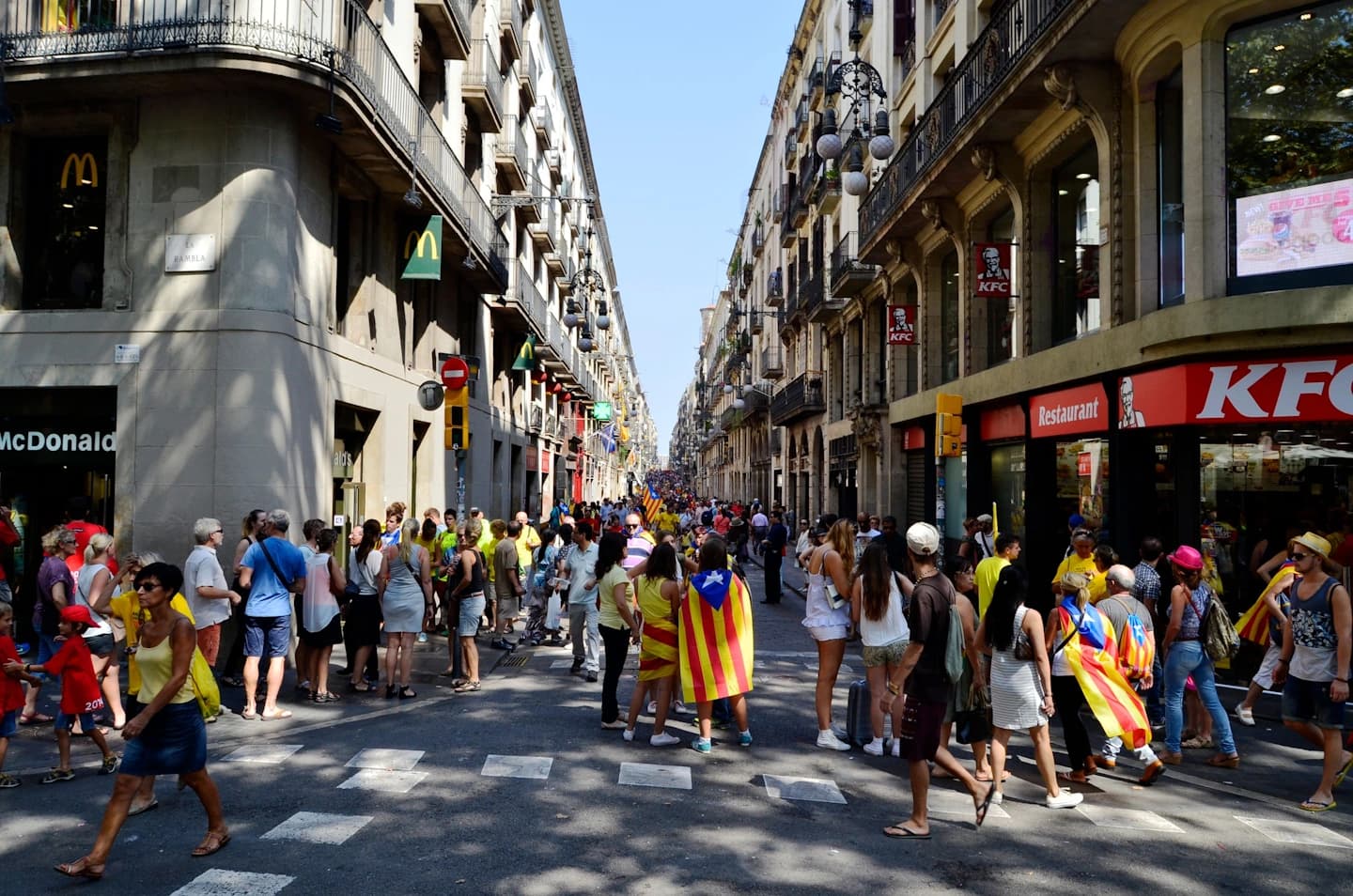
Catalan is used in schools, universities, government, newspapers, television, radio, publishing, theatre and music. Barcelona is one of the world's largest cities where Catalan is widely visible in public life.
Its modern history has also included periods of restriction. During the Franco dictatorship from 1939 to 1975, Catalan faced extensive restrictions in education, administration, publishing and broadcasting. Despite this, it continued to be transmitted within families and communities. (Generalitat de Catalunya)
Since the restoration of democracy, Catalan has regained an important institutional and cultural role.
For visitors to Barcelona, learning even a few words such as bon dia, gràcies or si us plau is a simple way to recognise the language and the culture that surrounds it. Catalan is not only a language of the past: it remains a living language spoken, written and developed by millions of people today.
Ready to explore Barcelona?
Build your personalised itinerary in 30 seconds — starting from your hotel.
Build my Barcelona route →Related articles
Why Do Catalans Say “Merci”? The Story Behind Gràcies, Mercès and Merci
Why do some Catalans say “merci”? Discover the history of gràcies, mercès and the French influence behind this familiar expression.
6 Oct 2026
Why Is Red Wine Called Tinto in Spain and Vi Negre in Catalonia?
Why is red wine called vino tinto in Spain and vi negre in Catalonia? Discover the linguistic history behind these unusual wine terms.
3 Oct 2026
Catedral de Barcelona: History, Construction and Interesting Facts
Discover Barcelona Cathedral’s history, from its ancient foundations and Gothic construction to its Neo-Gothic façade, famous figures and fascinating facts.
2 Oct 2026
Comments
Comments
Loading comments...
Sign in to leave a comment