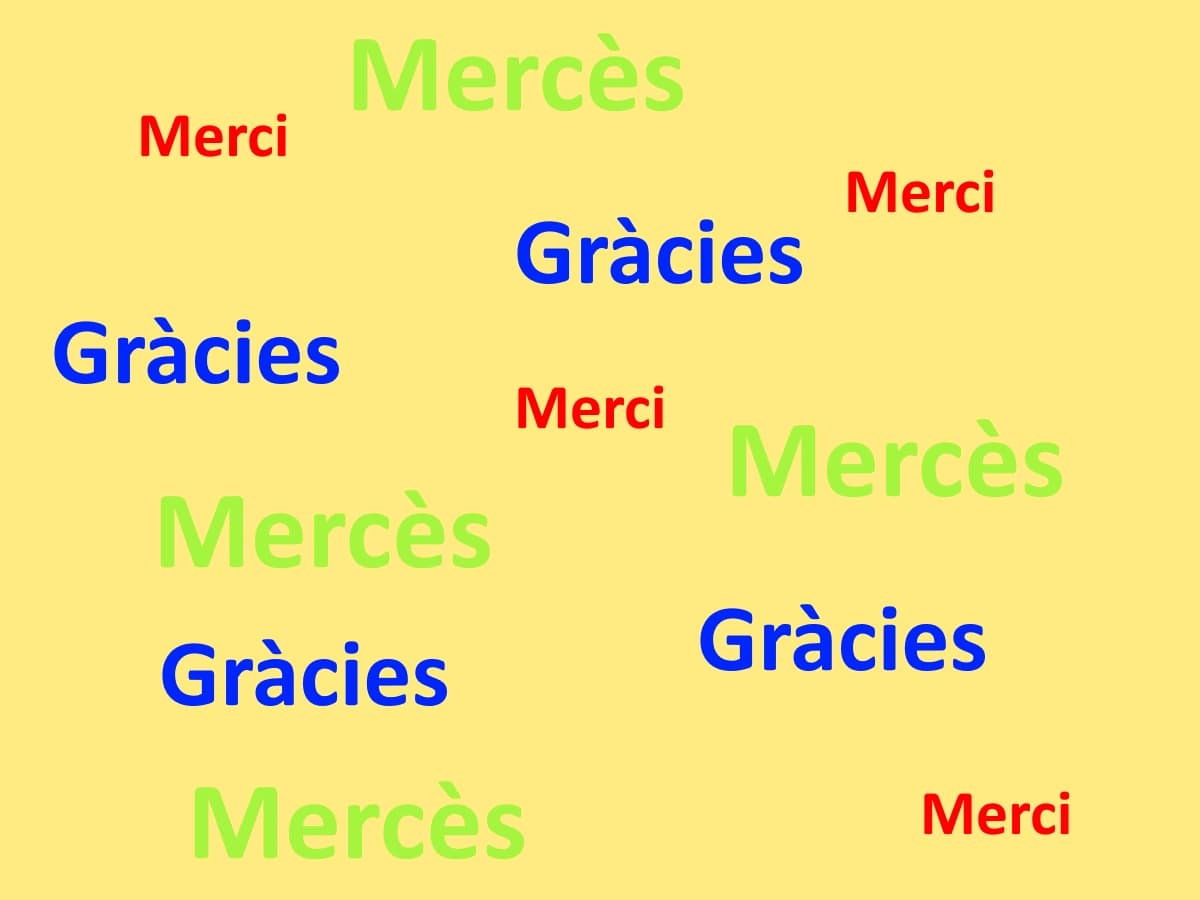
Why Do Catalans Say “Merci”? The Story Behind Gràcies, Mercès and Merci
Why do some Catalans say “merci”? Discover the history of gràcies, mercès and the French influence behind this familiar expression.
If you spend time in Barcelona or elsewhere in Catalonia, you may occasionally hear someone say “merci” instead of “gràcies” when thanking another person. For visitors, this can be confusing. Is merci actually a Catalan word? Has French influenced Catalan? And why do some Catalans use merci when gràcies is the normal word?
The short answer is that “gràcies” is the standard Catalan word for “thank you,” while “merci” is a familiar expression influenced by French. But the story is more interesting because Catalan has its own traditional word, mercès, which has been used for centuries.
Gràcies is the normal Catalan word
The most important thing for travelers to know is simple: if you want to say “thank you” in Catalan, say gràcies.
For example:
Gràcies! — Thank you!
Moltes gràcies! — Thank you very much!
Gràcies per tot! — Thanks for everything!
Gràcies, igualment! — Thanks, you too!
The word gràcies is not a modern borrowing from Spanish. It has a long history in Catalan. Medieval Catalan texts already used expressions involving gràcies to express gratitude. The linguist Pompeu Fabra specifically noted that gràcies was perfectly good Catalan and not a Castilianism.
The word ultimately comes from Latin gratia, meaning favour, goodwill or thanks, and is related to the same Latin root that produced words such as English grace and French grâce.
So where does “merci” come from?
Merci is French. In modern French, merci means “thank you,” and the word has a much older history connected with the idea of mercy, favour or graciousness.
Catalan has a closely related traditional word: mercè.
The Catalan mercè historically meant a favour, grace or act of goodwill. The Diccionari Català-Valencià-Balear records examples dating back to the Middle Ages. It also records mercès, particularly in the plural, as an expression of gratitude equivalent to “thanks.”
This means that merci may sound French to modern ears, but Catalan already had its own related vocabulary long before the contemporary use of merci became familiar.
Mercès: the traditional Catalan connection
This is where the story becomes especially interesting.
Mercès is a genuine Catalan word meaning “thanks,” although it is much less common in everyday modern speech than gràcies. Historical Catalan literature contains expressions such as grans mercès — literally “great thanks.”
Pompeu Fabra addressed this question directly in his writings on Catalan. He explained that mercès was also legitimate Catalan, and that it could be used to translate the French merci. At the same time, he rejected the idea that Catalan needed to replace gràcies with mercès.
So there are three words worth separating:
Gràcies — the normal modern Catalan “thank you.”
Mercès — a traditional Catalan word for thanks, still valid but less common.
Merci — a French expression that is also heard informally in Catalan conversation.
Why do some Catalans actually say “merci”?
The modern use of merci is best understood as informal linguistic influence rather than the replacement of gràcies.
Catalan exists in a multilingual environment. Catalans regularly encounter Spanish, French and other languages through travel, media, tourism and cultural contact. French has had particular historical importance in Catalonia, especially in northern Catalonia and across the Pyrenees.
As a result, French expressions can sometimes appear in informal Catalan speech.
There is also a certain playful or cosmopolitan quality to saying merci. Someone might use it casually, humorously or affectionately, much as speakers of many languages occasionally borrow familiar expressions from another language.
It does not mean that merci is the standard Catalan word for “thank you.”
Is “merci” more Catalan than “gràcies”?
No.
This is an important distinction, particularly because visitors sometimes hear merci and assume it is the Catalan equivalent of French merci.
If you are learning Catalan, gràcies is the word you should learn first. It is the ordinary and universally useful way to thank someone.
You may also hear moltes gràcies, which literally means “many thanks” and is completely natural.
Merci is something you may encounter in casual conversation, but it should not be treated as the defining Catalan word for gratitude.
A fascinating linguistic coincidence
There is nevertheless a genuine historical connection between the Catalan mercè/mercès family and French merci. Both ultimately belong to a wider Romance vocabulary inherited from Latin merces/mercedem, associated with reward, favour or graciousness.
Catalan therefore has two different but historically related routes for expressing thanks: gràcies, from the Latin family of gratia, and mercès, from the family of merces. French developed merci from the latter family.
That makes the occasional Catalan merci especially interesting. It is not simply a random French word dropped into Catalan. It resembles vocabulary that already has historical relatives within Catalan itself.
What should visitors say in Barcelona?
If you want to thank someone in Catalan, simply say:
“Gràcies!”
For extra politeness:
“Moltes gràcies!”
And if you hear a Catalan speaker say “merci,” don't be surprised. It is an informal expression you may encounter, but gràcies remains the standard Catalan word for “thank you.”
The story is a good example of how languages work in real life. Catalan has its own long history, while centuries of contact with neighbouring languages have added layers of vocabulary, expressions and informal habits. In Barcelona, you can sometimes hear those layers in a single, very small word of thanks.
Ready to explore Barcelona?
Build your personalised itinerary in 30 seconds — starting from your hotel.
Build my Barcelona route →Related articles
Why Do Catalans Love Poop? The Curious World of Caganers, Tió and Scatological Humour
Why do Catalans put poop in Christmas traditions? Discover the caganer, Tió de Nadal and the history of Catalan scatological humour.
7 Oct 2026
Why Is Red Wine Called Tinto in Spain and Vi Negre in Catalonia?
Why is red wine called vino tinto in Spain and vi negre in Catalonia? Discover the linguistic history behind these unusual wine terms.
3 Oct 2026
Ratafia: The Traditional Catalan Herbal Liqueur
Discover ratafia, Catalonia’s traditional herbal liqueur made with green walnuts, herbs and spices, including its history and recipe.
30 Sept 2026
Comments
Comments
Loading comments...
Sign in to leave a comment