Països Catalans: What Does the Term Mean, and Who Uses It?
What does Països Catalans mean? Explore its history, the role of Joan Fuster, the Catalan-speaking territories and why the term remains controversial.
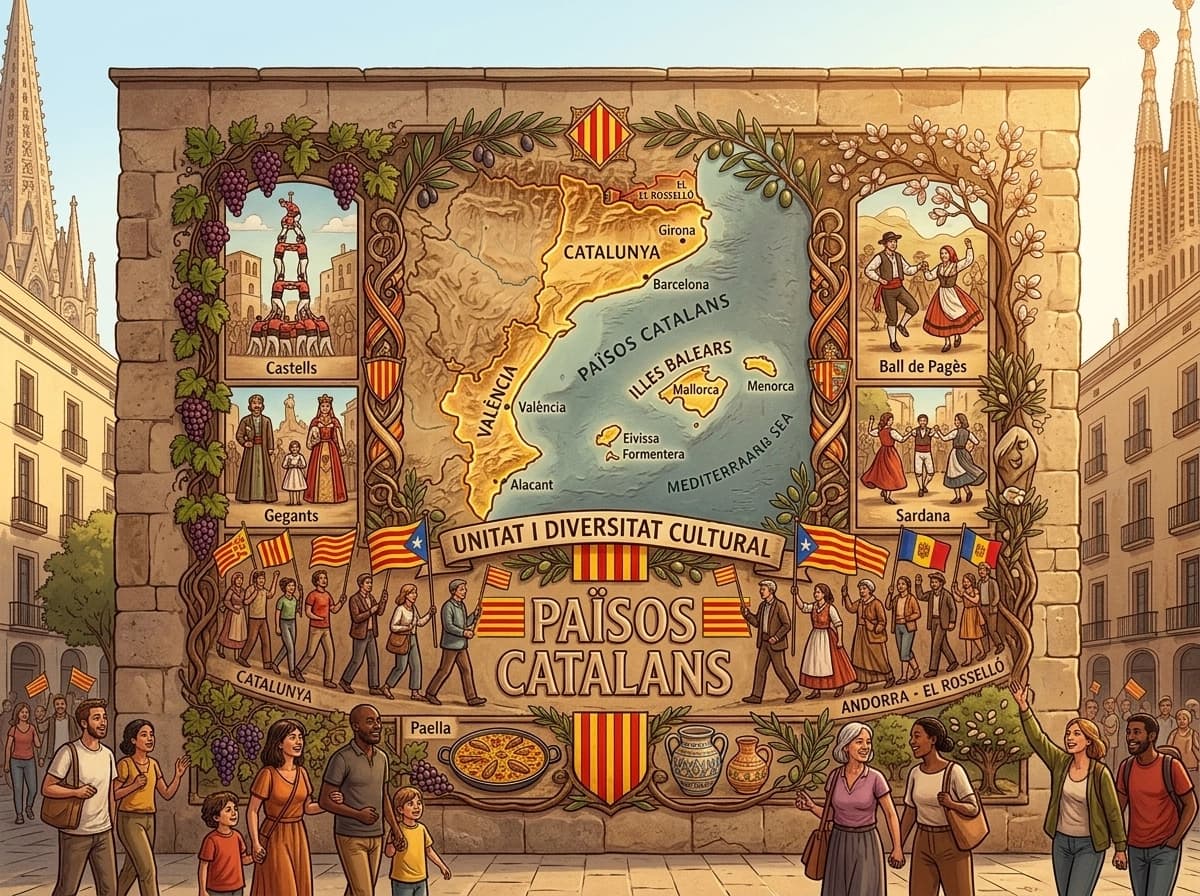
The expression Països Catalans, usually translated into English as “Catalan Countries”, is one of the most interesting and debated concepts in the history and identity of Catalonia. It refers broadly to territories where Catalan is traditionally spoken and where related linguistic and cultural traditions have developed. However, the term can also express a political idea: that these territories belong to a wider national community.
To understand the Països Catalans, it is important to distinguish between a shared language and culture, which are historical realities, and the political proposals associated with the name, which remain controversial.
What does Països Catalans mean?
In Catalan, països means “countries” or “lands”, while catalans means “Catalan”. The expression can therefore be translated as “Catalan Countries”.
In its broadest linguistic and cultural meaning, it describes the territories connected by the Catalan language, including its Valencian variety. These territories are spread across several present-day countries and administrative regions.
The areas most commonly associated with the concept are:
Catalonia: The autonomous community in northeastern Spain, with Barcelona as its capital.
The Valencian Community: The region on Spain’s eastern coast where the language is traditionally called Valencian.
The Balearic Islands: Including Mallorca, Menorca, Ibiza and Formentera.
Andorra: An independent state in the Pyrenees where Catalan is the official language.
Northern Catalonia: A historical Catalan-speaking area in southern France, mainly within the Pyrénées-Orientales department.
La Franja: Catalan-speaking communities in the eastern part of Aragon, Spain.
Alghero: A city in Sardinia, Italy, where a variety of Catalan is still spoken.
Some definitions include additional areas, such as El Carche in the Spanish region of Murcia, where Catalan is spoken in a smaller number of communities. The precise geographical boundaries can vary depending on whether the definition is strictly linguistic, historical or political.
These territories do not form a single administrative or political unit. They belong to different states and have their own institutions, laws and regional identities.
Who created the term?
The expression was not invented by the 20th-century Catalan nationalist movement, as is sometimes assumed. Its documented history goes back to the 19th century.
One of the earliest known printed uses appeared in 1876 in a work by Benvingut Oliver i Esteller, a Valencian jurist and historian. His book, Historia del Derecho en Cataluña, Mallorca y Valencia, used the expression países catalanes in Spanish-language text.
The term was subsequently used by other Catalan-language writers and intellectuals. In 1886, the Catalan federalist and writer Josep-Narcís Roca i Farreras used the expression in the publication L’Arc de Sant Martí.
Nevertheless, the phrase was not widely established at that time. Its modern meaning became much more influential during the 20th century, particularly through the work of the Valencian writer and intellectual Joan Fuster.
Joan Fuster and the modern idea
Joan Fuster (1922–1992) was a major Valencian essayist who wrote about language, history, culture and identity. In 1962, he published Nosaltres, els valencians (“We, the Valencians”), a highly influential book that reconsidered Valencian identity and its relationship with the wider Catalan-speaking world.
Fuster argued that language and shared cultural history connected Catalonia, Valencia and the Balearic Islands more closely than their separate political institutions suggested. He helped popularise Països Catalans as a name for this wider community.
For Fuster, the expression was not merely a geographical description. It also formed part of a political and cultural project: the idea that Catalan-speaking territories could recognise their common identity and potentially develop closer political relationships.
His ideas influenced sections of Catalan and Valencian cultural and political movements, particularly during the final decades of Franco’s dictatorship, when the public use of regional languages and the expression of regional identities faced restrictions.
Fuster did not invent the words themselves. His importance lies in popularising the expression and giving it a particularly influential modern interpretation.
Where is the term used today?
The expression appears in different contexts, including academic writing, cultural associations, language activism, publishing and political debate.
In Catalonia, it is used by some people who emphasise the cultural and linguistic unity of the Catalan-speaking territories. Certain Catalan nationalist and pro-independence groups also use it to describe a wider national community that extends beyond the borders of Catalonia's autonomous community.
In Valencia, the term has a more complicated reception. Some intellectuals, activists and political groups support Fuster’s idea of a shared Catalan-speaking cultural space. Others strongly prefer to emphasise a distinct Valencian identity and reject the political implications they associate with Països Catalans.
In the Balearic Islands, attitudes also vary. Some people value the connection created by the Catalan language, while others prioritise the islands’ distinct historical and regional identities.
The expression can also appear in discussions of language preservation and cultural cooperation in Andorra, Northern Catalonia and other Catalan-speaking communities. Using it in a cultural or linguistic sense does not necessarily mean supporting political unification.
Why is the term controversial?
The controversy comes from the fact that Països Catalans can mean different things to different people.
For linguists and cultural historians, it can be a convenient way to describe a broad language area whose communities share related linguistic traditions, literature and historical connections.
For supporters of a wider Catalan national project, it can express the belief that these communities form a nation extending beyond present-day administrative borders.
Critics may see the same expression as an attempt to place distinct territories under a Catalan national identity they do not share. In Valencia and the Balearic Islands in particular, the term can be perceived as overlooking local identities, political preferences and historical differences.
It is therefore inaccurate to assume that everyone who speaks Catalan identifies with the Països Catalans as a political project. A person can speak Catalan, support its preservation and recognise its shared cultural history while identifying primarily as Valencian, Mallorcan, Andorran, Catalan or French.
A shared language does not mean a shared government
Historically, the territories associated with the Països Catalans have experienced different political developments. Parts of the eastern Iberian Peninsula and the Mediterranean islands were connected through the expansion of the Crown of Aragon during the Middle Ages. Yet their subsequent histories, institutions and relationships with neighbouring states diverged.
Today, Catalonia, the Valencian Community and the Balearic Islands are separate autonomous communities within Spain. Andorra is an independent state, while Northern Catalonia belongs to France and Alghero to Italy. Their legal systems, political institutions and official language arrangements are not the same.
There is no government or unified state representing the Països Catalans as a whole. Nor is the expression the official name of a single political territory.
Cooperation between Catalan-speaking communities can take place through cultural organisations, educational initiatives, publishing, broadcasting and language projects. Such cooperation does not require agreement on political unification.
Països Catalans and Catalonia: what is the difference?
The distinction is straightforward but important. Catalonia usually means the autonomous community in northeastern Spain. Països Catalans refers to a broader and less universally accepted concept encompassing several Catalan-speaking territories.
The first is an established political and administrative entity. The second is a linguistic and cultural description that can also carry political meaning, depending on who uses it and in what context.
For visitors to Barcelona, understanding this distinction helps explain some of the debates surrounding Catalan identity, regional nationalism and the relationship between language and territory.
The Països Catalans are best understood not as a single country, but as a concept shaped by a shared language, historical connections and differing ideas about collective identity. Its significance lies both in the cultural ties it describes and in the continuing debate over what those ties should mean politically.
Ready to explore Barcelona?
Build your personalised itinerary in 30 seconds — starting from your hotel.
Build my Barcelona route →Related articles
Okupas in Spain: The Situation in Catalonia and Barcelona
Explore the debate over okupas in Spain, with a focus on Catalonia and Barcelona, current statistics, public opinion and possible solutions.
11 Oct 2026
Why Do Catalans Love Poop? The Curious World of Caganers, Tió and Scatological Humour
Why do Catalans put poop in Christmas traditions? Discover the caganer, Tió de Nadal and the history of Catalan scatological humour.
7 Oct 2026
Ratafia: The Traditional Catalan Herbal Liqueur
Discover ratafia, Catalonia’s traditional herbal liqueur made with green walnuts, herbs and spices, including its history and recipe.
30 Sept 2026
Comments
Comments
Loading comments...
Sign in to leave a comment