Castellers: The Human Towers of Catalonia
Discover the castellers, Catalonia’s famous human towers. Learn their history, how they train, how castells are built and why this tradition matters.
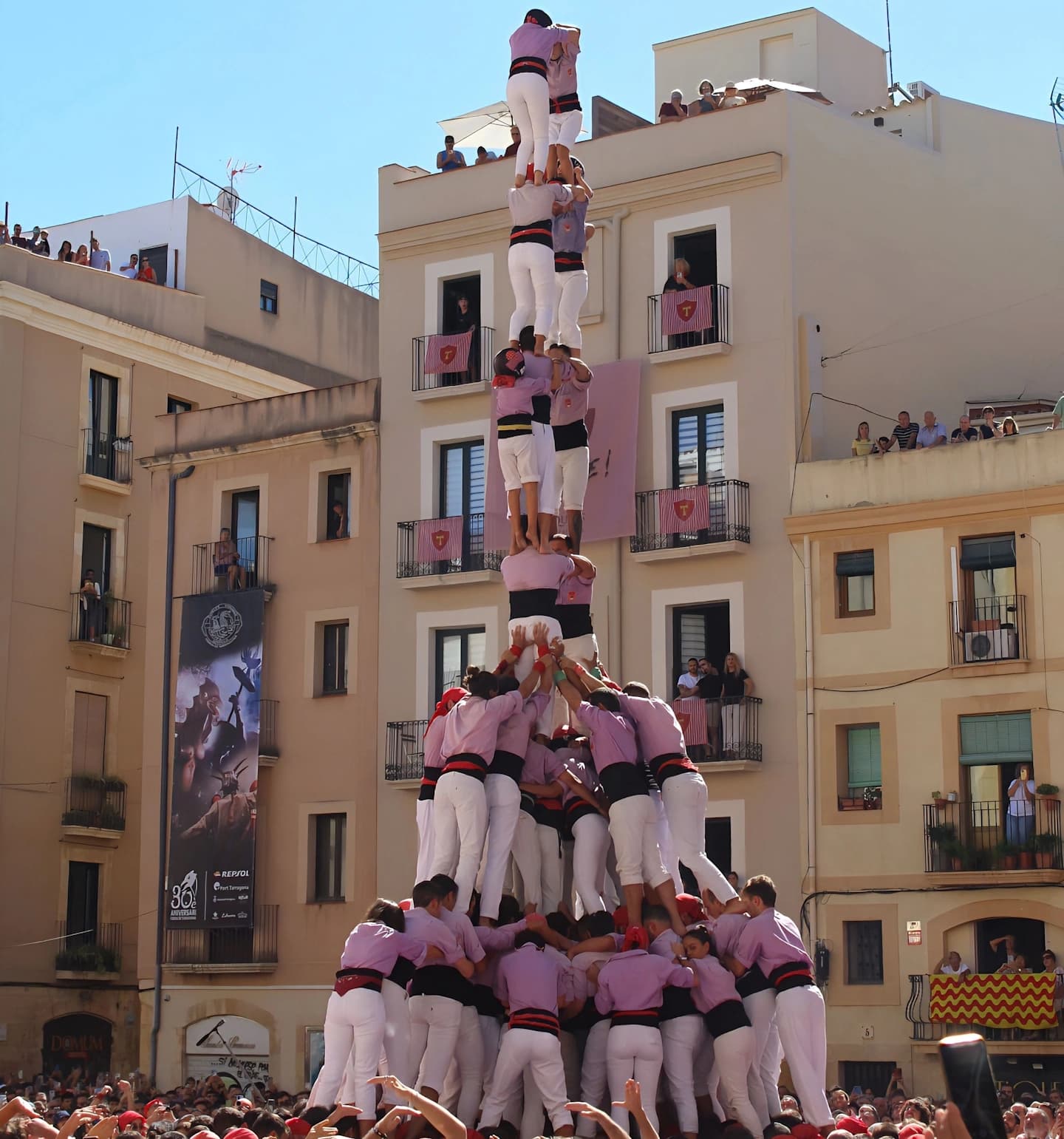
If you attend a festa major in Catalonia, you may see something that looks almost impossible: dozens of people joining together to build a human tower several metres high. These are castells, and the people who build them are known as castellers.
For more than 200 years, castells have been one of Catalonia's most distinctive popular traditions. They combine physical strength, balance, coordination and courage, but their deeper meaning is about teamwork and community. In 2010, UNESCO added the tradition to its Representative List of the Intangible Cultural Heritage of Humanity.
When did castells begin?
The origins of castells are generally placed in the 18th century around Valls and the Camp de Tarragona. The tradition developed from the Ball dels Valencians, a popular dance that ended with people forming human figures or small towers. Over time, the tower became more important than the dance itself, eventually developing into the castells we know today.
The oldest documented human tower dates from 1770 in L'Arboç, while an important early record from Valls dates to 1791. By the beginning of the 19th century, groups known as colles were already forming and competing to build increasingly tall and difficult towers.
Competition helped drive the tradition forward. In 1819, for example, one of the Valls groups successfully built an eight-level tower, an extraordinary achievement for its time. During the 19th century, castells became increasingly sophisticated, with towers reaching nine levels.
How does a castell work?
A castell is built from several sections. At the bottom is the pinya, a large group of people forming the supporting base. The pinya provides stability and also helps protect the people above if the structure loses balance.
Above it is the tronc, the central part of the tower. Depending on the type of castell, people form successive levels by standing on each other's shoulders.
At the top is the pom de dalt, normally made up of smaller and lighter young participants. The very top participant, the enxaneta, climbs into position and raises four fingers in the traditional gesture known as the aleta. That moment signals that the tower has been successfully crowned.
The traditional gralla, a Catalan wind instrument, provides the musical rhythm during the construction. The music helps castellers follow the different stages of the performance.
How do people learn to become castellers?
You cannot learn to build a castell simply by watching a performance. The knowledge is traditionally passed from experienced castellers to new members through regular practice and repetition.
A new participant normally joins a colla and begins with basic positions, often in the pinya. Beginners learn how to stand, where to place their hands, how to communicate with the people around them and how to respond if the tower moves.
Training then becomes more specialised. Depending on a person's size, strength, balance, confidence and experience, they may eventually take different positions in the pinya, tronc or upper levels.
There is no fixed number of months or years required to become a casteller. It depends entirely on the person and the position they want to learn. Some basic participation can begin quickly, while climbing higher levels requires considerably more experience and trust.
Barcelona's casteller groups, for example, explicitly welcome beginners and teach new members progressively, beginning with safety instructions and basic positions in the pinya.
Is it dangerous?
Castells involve genuine physical risk, which is why training and safety procedures are essential. Participants use the traditional faixa, a wide cloth sash around the waist that provides support and gives climbers something to grip.
Young climbers also use helmets, introduced into the tradition in 2006 as part of improved safety measures.
Modern casteller groups use structured training, experienced technical teams and carefully organised formations. The large pinya also provides a substantial supporting and protective structure beneath the tower.
Why are castells so important?
The importance of castells goes far beyond building the tallest possible tower.
A successful castell requires people of different ages, sizes and abilities to perform different roles. Some climb, others form the foundation, while others organise the group, play music or coordinate the performance.
UNESCO specifically recognised the tradition for its contribution to social cohesion, solidarity and a sense of continuity between generations.
Today, there are close to 100 colles and more than 12,000 castellers, with thousands of towers built each year. The tradition has also expanded well beyond its original area around Tarragona and is now practised across Catalonia.
For visitors, seeing a castell is one of the best ways to experience Catalan popular culture. The impressive height catches the eye, but the real story is happening underneath: dozens of people trusting one another and working together to create something that no individual could build alone.
That is why the traditional saying associated with castells is so appropriate: “Força, equilibri, valor i seny” — strength, balance, courage and common sense.
Ready to explore Barcelona?
Build your personalised itinerary in 30 seconds — starting from your hotel.
Build my Barcelona route →Related articles
Why Do Catalans Love Poop? The Curious World of Caganers, Tió and Scatological Humour
Why do Catalans put poop in Christmas traditions? Discover the caganer, Tió de Nadal and the history of Catalan scatological humour.
7 Oct 2026
Why Do Catalans Say “Merci”? The Story Behind Gràcies, Mercès and Merci
Why do some Catalans say “merci”? Discover the history of gràcies, mercès and the French influence behind this familiar expression.
6 Oct 2026
Ratafia: The Traditional Catalan Herbal Liqueur
Discover ratafia, Catalonia’s traditional herbal liqueur made with green walnuts, herbs and spices, including its history and recipe.
30 Sept 2026
Comments
Comments
Loading comments...
Sign in to leave a comment