Correfoc: Catalonia’s Festival of Fire and Devils
Discover the Catalan correfoc, a spectacular festival of devils, dragons, fireworks and fire with medieval roots and modern traditions.
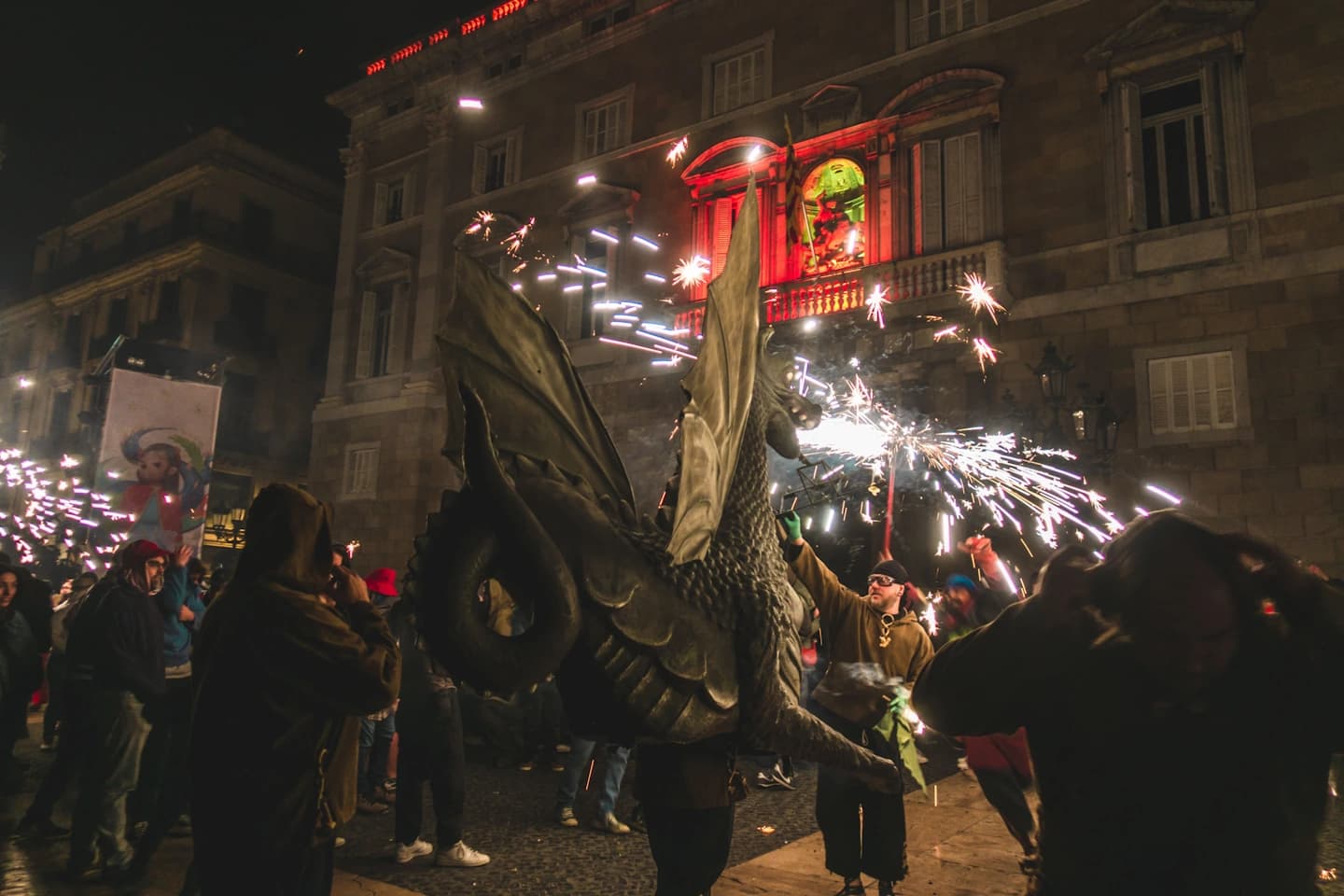
Few Catalan traditions are as spectacular as the correfoc. During this unusual street celebration, people dressed as devils run through the streets carrying fireworks, while dragons and other fire-breathing beasts send showers of sparks into the air. Drums, explosions, smoke and crowds turn an ordinary street into a moving spectacle of fire.
The name correfoc literally means “fire run” — córrer (to run) and foc (fire). Although the tradition has much older roots, the modern correfoc is a relatively recent form of Catalan popular festival.
What is a correfoc?
A correfoc is a street performance involving colles de diables, or groups of devils, and often fire beasts such as dragons, bulls or other large figures.
The participants carry fireworks known as carretilles, producing showers of sparks as they move along a planned route. The devils dance and run to the rhythm of drums, while spectators gather along the streets or, in some cases, participate by moving underneath the sparks.
The atmosphere is deliberately chaotic and theatrical, but the event itself is carefully organised. Routes, firework use, participants and safety arrangements are controlled by the organisers. Barcelona's official safety guidance, for example, specifically instructs spectators to respect the fire performers and their route.
Ancient roots, modern name
The history of the correfoc reaches much further back than the word itself.
Catalan devils and fire traditions have connections with medieval Corpus Christi celebrations. Barcelona has documented references to devils participating in processions from at least the 15th century, while earlier medieval processions included theatrical figures known as entremesos. These performances mixed religion, theatre, symbolism and popular entertainment.
Over the centuries, the role of the devil changed. Originally, the figure could represent evil in religious performances, but later devil characters also became comic, satirical and festive figures.
The modern correfoc emerged in Barcelona in 1979. It developed from the city's Mostra de Bèsties Fantàstiques, an event created as part of the renewal and popularisation of the Festa Major de la Mercè. According to Barcelona's official cultural history, the event quickly became known as the correfoc and its format subsequently spread throughout Catalonia.
This explains an interesting fact: the fire tradition is centuries old, but the correfoc as we know it today is largely a product of the late 20th century.
When can you see a correfoc?
Correfocs are particularly common during a festa major, the annual festival of a Catalan town, neighbourhood or city.
In Barcelona, one of the best-known examples is the Correfoc de la Mercè, held as part of the city's major annual festival. It brings together numerous devil groups and fire beasts and has become one of the most anticipated events of La Mercè. Barcelona's cultural protocol describes the correfoc as an essential part of the city's modern festive tradition.
Smaller neighbourhood correfocs take place throughout the year. Groups such as the Diables de l'Esquerra Infernal, for example, organise or participate in correfocs connected with neighbourhood festivals both in Barcelona and elsewhere.
There are also versions designed specifically for children, usually called correfoc infantil or similar. These use smaller-scale fireworks and are organised with additional precautions.
Is a correfoc dangerous?
Yes. A correfoc involves real fire, fireworks, sparks, heat, smoke and loud explosions, so there is a genuine risk of burns or other injuries. It should not be treated like an ordinary street parade.
Spectators who want to experience the event from close range are normally advised to wear long sleeves and long trousers, preferably made from cotton, closed shoes and eye protection. Barcelona's safety guidance also recommends protecting the ears and following the instructions of the organisers, police and fire groups.
Children should be kept away from the front rows, and spectators should never interfere with the devils or fire beasts. Unused fireworks or unexploded material should never be picked up or handled.
You can also enjoy a correfoc safely from further back. You do not need to enter the area directly underneath the sparks to experience the atmosphere.
Why is the correfoc important in Catalan life?
The correfoc represents the way traditional culture can change while remaining connected to the past. Its characters have medieval roots, but the modern format was created in Barcelona in the late 20th century and quickly became part of festivals across Catalonia.
It is also strongly connected to local community life. Behind a correfoc is usually a colla de diables — a community group that rehearses, organises performances and passes knowledge between generations.
Fire is also an important element in other Catalan celebrations. At La Patum de Berga, for example, fire devils known as plens are among the central figures of a Corpus festival with roots reaching back to the medieval period. La Patum was recognised by UNESCO as intangible cultural heritage in 2005.
For visitors, a correfoc can seem wild and spontaneous. In reality, it combines centuries-old characters, modern festival culture, community organisation and carefully managed pyrotechnics.
That mixture is what makes the correfoc such a distinctive part of Catalan life: it is not simply a fireworks show, but a living street tradition in which the performers and the public become part of the same celebration of fire.
Ready to explore Barcelona?
Build your personalised itinerary in 30 seconds — starting from your hotel.
Build my Barcelona route →Related articles

Why Do Catalans Love Poop? The Curious World of Caganers, Tió and Scatological Humour
Why do Catalans put poop in Christmas traditions? Discover the caganer, Tió de Nadal and the history of Catalan scatological humour.
7 Oct 2026
Why Do Catalans Say “Merci”? The Story Behind Gràcies, Mercès and Merci
Why do some Catalans say “merci”? Discover the history of gràcies, mercès and the French influence behind this familiar expression.
6 Oct 2026
Ratafia: The Traditional Catalan Herbal Liqueur
Discover ratafia, Catalonia’s traditional herbal liqueur made with green walnuts, herbs and spices, including its history and recipe.
30 Sept 2026
Comments
Comments
Loading comments...
Sign in to leave a comment